
Share this post:


How many probiotics are in kefir – & why CFUs vary

Probiotics are revolutionising how we approach our health – these tiny titans can improve digestion, boost the immune system and even uplift your mood! Probiotic supplements and foods, like kefir, have become increasingly popular, but research is ongoing to explore all the ways these microorganisms can impact us.
Kefir is one of the most popular sources of probiotics, but it’s important to understand that there isn’t a single fixed number of probiotics in a glass of kefir. At Chuckling Goat, we believe kefir is a fantastic way to support gut health, and outshines other supermarket brands, and in this guide, we’ll explain why — with all the facts upfront.

Direct Answer: CFUs in kefir
Probiotic bacteria is measured in Colony Forming Units (CFUs), this measure indicates the number of viable cells that can reproduce to form bacterial colonies.1https://study.com/academy/lesson/what-is-a-colony-forming-unit-definition
There is no single, fixed probiotic count in real kefir. Because kefir made with live grains continues to ferment, the number of live bacteria and yeasts changes over time. Factors such as fermentation time, temperature, milk type, and storage conditions all influence the total Colony Forming Units (CFUs).
A typical 170ml serving of live kefir contains billions of probiotic bacteria and yeasts, but what matters most is the diversity of strains and their ability to survive the digestive tract, rather than just the raw CFU number.
What CFUs measure (& what they don’t!)
CFUs, or Colony Forming Units, indicate the number of viable microorganisms that can reproduce to form colonies. 2https://study.com/academy/lesson/what-is-a-colony-forming-unit-definition
While CFUs provide a snapshot of bacterial count, they don’t capture diversity, survivability, or activity in the gut, which are often more important for supporting digestive health.
Why Kefir CFUs vary
Real kefir made with kefir grains, continues to ferment over time, increasing the live bacteria count, so there is no way of fixing the CFUs. The probiotic count depends on a number of factors such as initial fermentation duration, temperature, milk composition and storage conditions. Eventually, the bacterial count will plateau and start to gradually decrease.

Studies show wide variation:
One study measured after 24 hours of fermentation: 100,000,000 CFU/mL Lactobacillus, 100,000 CFU/mL Lactococcus, 1,000,000 CFU/mL yeasts, and 1,000,000 CFU/mL acetic acid bacteria.3https://www.cambridge.org/core/journals/nutrition-research-reviews/article/milk-kefir-nutritional-microbiological-and-health-benefits/
Another review shows ranges of 64,000 CFU/g to 850,000,000 CFU/g for bacteria and 150,000 CFU/g to 370,000,000 CFU/g of yeasts.4https://www.sciencedirect.com/topics/food-science/kefir
Even with this variability, a single glass contains billions of live microorganisms, making kefir a rich and natural source of probiotics.
Chuckling Goat kefir vs. supermarket brands
Chuckling Goat kefir contains 27 live strains, whereas most supermarket kefirs contain 3–13 strains. This difference comes from the fermentation method:
- CG kefir uses live kefir grains, which continue fermenting and allow bacteria to remain active.
- Supermarket kefir often uses freeze-dried cultures or pasteurisation, which limits strain diversity and survival.
Independent testing at Aberystwyth University confirmed that CG kefir contains non-transient bacteria that survive digestion.5https://www.frontiersin.org/journals/microbiology/articles/l
Supermarket kefirs may also contain added sugars or stabilisers, which can affect inflammation and gut dysbiosis.6https://pmc.ncbi.nlm.nih.gov/articles/PMC6835893/ Our kefir is pure and unflavoured for maximum therapeutic benefit.
Still not sure? You can learn to spot the differences yourself from our article REAL kefir vs FAKE kefir: 10 key differences.

Why diversity matters more than CFUs
While CFUs tell part of the story, strain diversity and survivability are critical for gut health:
- Kefir contains beneficial yeasts alongside probiotics, which can support antimicrobial activity and help bacteria thrive.7https://www.frontiersin.org/journals/microbiology/articles/8https://pubmed.ncbi.nlm.nih.gov/16854180/
- Diverse strains interact differently in the gut, which may improve digestion, support immunity, and influence the gut-brain axis.
The importance of prebiotics
Prebiotics are non-digestible plant fibres that feed the good bacteria – probiotics – in your gut.9https://pmc.ncbi.nlm.nih.gov/articles/PMC6463098/
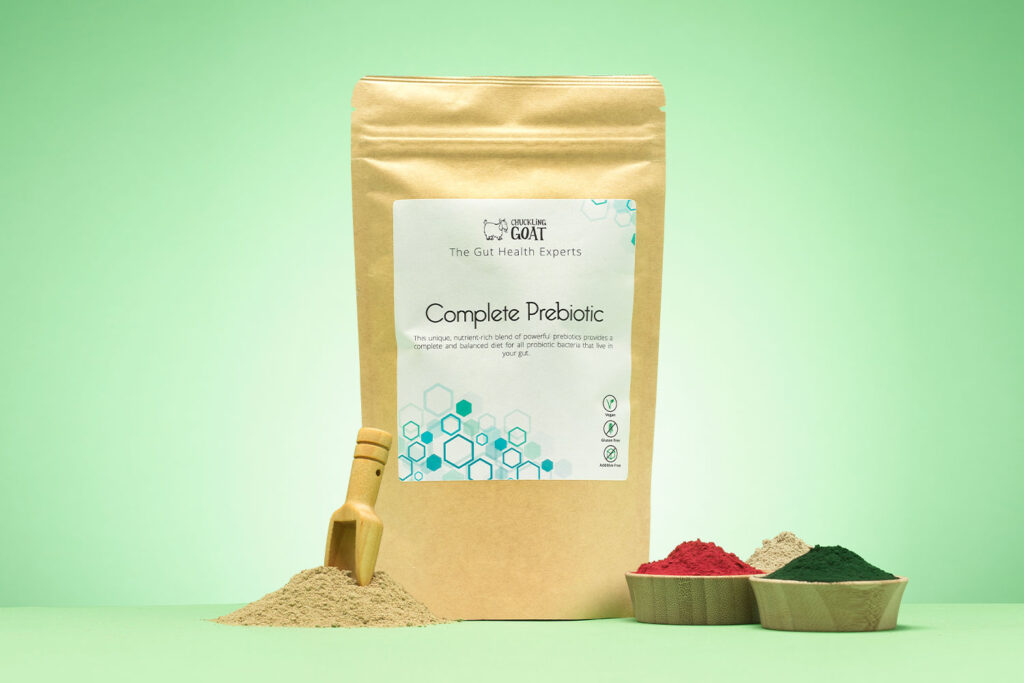
Prebiotics can be found in foods such as asparagus, chicory, onion, garlic, soybean, sugar beet, rye, peas and many more.10https://pmc.ncbi.nlm.nih.gov/articles/PMC6463098/ At Chuckling Goat, our Complete Prebiotic combines 14 ingredients with 18 different fibres to maximise diversity.
Another underrated source of prebiotic fibres is mushrooms – yep, that’s right! Medicinal mushrooms such as Reishi (Ganoderma lucidum) and Turkey Tail (Trametes versicolor) contain high levels of beta-glucans11https://pubmed.ncbi.nlm.nih.gov/37468715/, you can find both of these in our Complete Mushroom Blend.
Pairing kefir with prebiotics enhances its benefits, allowing the gut microbiome to thrive.
So, should you take kefir as a probiotic source?
Yes! Live, fermented kefir made with real grains is an effective and natural source of probiotics. While CFU counts fluctuate, kefir offers diverse, survivable strains that support gut health. For best results, pair with prebiotics and start slowly if you’re new to probiotics.
If you’re struggling with the taste of real kefir, mix it up in a Gut Health Smoothie with prebiotics and collagen for an extra gut-health boost.
Important: Avoid kefir alongside immunosuppressants unless cleared by your doctor. For other contraindications, consult your GP.
Want to learn more? Check out Why kefir has outlived every wellness fad
Any questions? Contact one of our Nutritional Therapists via live chat, weekdays from 8am to 8pm.
References
- 1
- 2
- 3
- 4
- 5
- 6
- 7
- 8
- 9
- 10
- 11