
Share this post:


Leaky gut: Fact, fiction or misunderstood science?

Leaky gut is everywhere on social media and wellness circles. You’ve probably seen claims that a leaky gut is responsible for everything from bloating and fatigue to brain fog, skin problems and autoimmune conditions.
But is leaky gut actually real – or is it just another wellness buzzword?
The short answer: increased intestinal permeability is real. Scientists have been studying how the gut barrier becomes more permeable for decades, and there is good evidence that this can happen in certain health conditions.
However, the popular idea of “leaky gut syndrome” is much more controversial. It’s not a formal medical diagnosis, and we still have plenty to learn about exactly what increased intestinal permeability means for our health.
So, let’s separate the science from the social media hype and take a closer look at what’s really going on inside your gut.
What is the gut barrier?
Before we get to “leaky gut”, it helps to understand what a healthy gut barrier actually does.
After your food is broken down in the stomach, it moves through the small intestine and then into the large intestine. Along the way, nutrients and water are absorbed, while waste eventually makes its way to the toilet (yep, that’s the glamorous bit of gut science!).
Your intestinal lining is much more than a simple tube. It’s a complex, living barrier made up of epithelial cells, mucus, tight junctions, immune cells and your resident microbes.
Its job is to let useful things through while helping to keep potentially harmful substances where they belong: inside the gut.
The small intestine
The lining of the small intestine contains tiny finger-like projections called villi, with structures called crypts between them.
The crypts generate epithelial cells that line the small intestine, which migrate up the villi. These epithelial cells form a single layer lining the intestine, creating an important barrier between the contents of your gut and the rest of your body.
These epithelial cells include absorptive cells called enterocytes, along with specialised cells such as goblet cells, which produce mucus, and Paneth cells, which produce antimicrobial substances.
And this lining isn’t static. It’s constantly being renewed, helping maintain the integrity and function of the gut barrier.
The epithelial cells are covered by a mucus layer, produced largely by specialised cells called goblet cells. This mucus acts as the first line of defence, helping to keep bacteria and other potentially harmful substances from coming into direct contact with the intestinal lining. In the small intestine, the mucus layer is relatively loose and contains antimicrobial substances that help control the number of bacteria close to the epithelial surface.
Epithelial cells are connected by structures called tight junctions. Think of them like tiny gates between the cells. Certain proteins regulate what can pass between these cells and play an important role in controlling intestinal permeability. Rather than simply being static, tight junctions are dynamic structures that carefully regulate the movement of water, ions, and small molecules between cells, while restricting the passage of larger or potentially harmful substances.1https://pmc.ncbi.nlm.nih.gov/articles/
In other words, your gut isn’t supposed to be a completely sealed wall. Some things need to get through. The clever part is how selectively it allows them to do so.
The large intestine
The large intestine is a little different. It doesn’t have villi, although it does contain crypts and a specialised epithelial lining.
It’s also home to an enormous community of microorganisms. While microbes are found throughout the gastrointestinal tract, the large intestine contains the greatest concentration of bacteria.
So, when we talk about the gut microbiome, we’re talking about the community of microorganisms living in the large intestine!2https://www.sciencedirect.com/science/article/
The large intestine has a particularly important mucus barrier because of its high bacterial density. This mucus is organised into two main layers: a dense inner layer that helps keep bacteria away from epithelial cells, and a looser outer layer that provides a habitat for many microbes.
The epithelial cells, mucus, tight junctions and immune system work together to maintain this barrier.
And your microbes aren’t just passive passengers. Beneficial bacteria can produce metabolites called short-chain fatty acids (SCFAs), including acetate, propionate, and butyrate. These compounds interact with intestinal cells and the immune system, and can help support the gut environment and barrier function.3https://pmc.ncbi.nlm.nih.gov/articles/
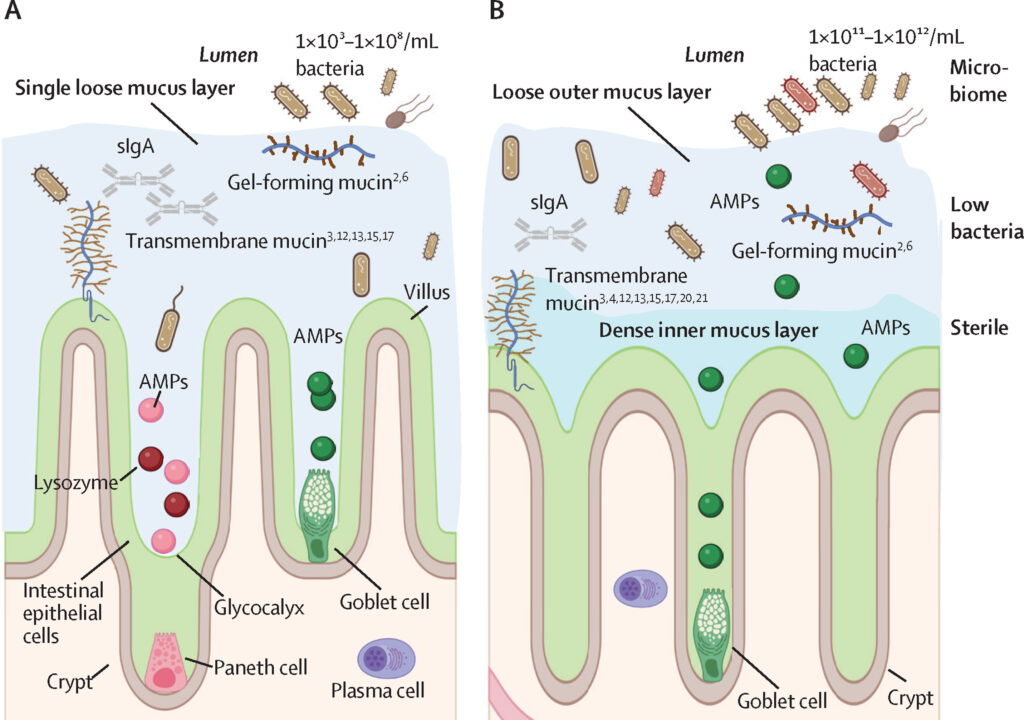
A: Small intestine; B: Large intestine4https://www.sciencedirect.com/science/article/
What is “leaky gut”?
“Leaky gut” is the informal term commonly used to describe increased intestinal permeability.
Your intestinal barrier is naturally permeable – otherwise nutrients and water wouldn’t be able to get from your digestive tract into your body.
The problem is when the barrier becomes more permeable than it should be.
Changes to the intestinal lining or tight-junction function can increase the movement of substances across the gut barrier. This may allow larger molecules and bacterial products greater access to the tissues underneath the intestinal lining.5https://www.nature.com/articles/6https://my.clevelandclinic.org/health/
What does LPS have to do with “leaky gut”?
You may have come across lipopolysaccharide (LPS) when reading about leaky gut.
LPS, sometimes called endotoxin, is a component of the outer membrane of Gram-negative bacteria. These bacteria naturally live in your gut, so LPS is not automatically a bad thing.
Normally, the intestinal barrier helps prevent significant amounts of LPS from reaching the circulation. When barrier function is disrupted, however, bacterial products such as LPS may have greater access to tissues and the bloodstream, interacting with the immune system and triggering inflammatory responses.7https://pmc.ncbi.nlm.nih.gov/articles/8https://pmc.ncbi.nlm.nih.gov/articles/
And here’s where things get interesting: the relationship can work in both directions.
Inflammation can affect tight-junction proteins and intestinal barrier function, potentially increasing permeability. This means barrier dysfunction and inflammation may reinforce one another in some circumstances.9https://pmc.ncbi.nlm.nih.gov/articles/
“Leaky gut” vs “leaky gut syndrome”
Here’s an important distinction.
Increased intestinal permeability is a genuine biological phenomenon. “Leaky gut syndrome” is a much broader and more controversial concept.
“Leaky gut syndrome” isn’t currently recognised as a formal medical diagnosis. Part of the controversy comes from claims that a leaky gut is the underlying cause of a huge range of unrelated symptoms and conditions, including fatigue, brain fog, allergies, and autoimmune diseases.
There are associations between intestinal permeability and a number of health conditions, but association doesn’t necessarily tell us which came first.
Did increased permeability contribute to the condition? Did the condition cause changes in the gut barrier? Or could both be happening at the same time? Researchers are still investigating these questions.
There also isn’t currently a universally accepted clinical test that can diagnose “leaky gut syndrome” itself.10https://my.clevelandclinic.org/health/11https://www.medicalnewstoday.com/articles/
What causes increased intestinal permeability?
Your intestinal barrier is influenced by lots of different factors. Diet, alcohol, medication, stress, the gut microbiome and underlying health conditions can all play a role.
- Gut dysbiosis – An imbalance in the gut microbiome can affect the tight junctions that hold intestinal cells together and alter the production of beneficial compounds such as SCFAs. These microbial metabolites help support the intestinal barrier, with butyrate in particular playing an important role in maintaining tight-junction integrity.12https://pmc.ncbi.nlm.nih.gov/articles/
- Diet – Dietary patterns low in fibre and higher in certain components associated with a Western-style diet, including saturated fat, sugars, and highly processed foods, have been associated with changes in the gut microbiome and intestinal barrier function.13https://pubmed.ncbi.nlm.nih.gov/
- Alcohol – Excessive alcohol consumption can affect intestinal epithelial cells, tight-junction proteins, and the gut microbiome. Alcohol and its metabolites can also promote inflammation, potentially compromising barrier function.14https://pmc.ncbi.nlm.nih.gov/articles/
- Medications – Some medicines, including NSAIDs such as ibuprofen, can affect the intestinal lining and increase intestinal permeability.15https://pmc.ncbi.nlm.nih.gov/articles/
- Stress – Chronic stress activates the HPA axis, increasing stress hormones such as cortisol, which can influence tight junctions and intestinal barrier function.16https://pmc.ncbi.nlm.nih.gov/articles/
Increased intestinal permeability can also occur alongside conditions such as coeliac disease and inflammatory bowel disease.
In these cases, it’s particularly important not to assume that permeability is necessarily the original cause. In many conditions, changes to the intestinal barrier may be a consequence of the underlying disease.17https://my.clevelandclinic.org/health/18https://pmc.ncbi.nlm.nih.gov/articles/
Signs, symptoms & tests
There isn’t a specific set of symptoms that proves you have increased intestinal permeability. Many symptoms commonly attributed to “leaky gut” can also occur with other digestive or health conditions.
Common symptoms can include:19https://www.medicalnewstoday.com/articles/20https://my.clevelandclinic.org/health/diseases/
- Diarrhoea
- Constipation
- Bloating
- Fatigue
- Headaches
- Skin complaints such as acne or eczema
- Joint pain
- Nutritional deficiencies
Testing for intestinal permeability
While there is no universally accepted test for intestinal permeability, there are different tests you can do and markers to look at that may indicate increased permeability and poorer gut barrier function; these are:
- Lactulose:mannitol test – Often considered the gold-standard research method for measuring small intestinal permeability. You drink a solution containing two sugars: lactulose, a larger molecule that normally crosses the intestinal barrier only in small amounts, and mannitol, a smaller molecule that is more readily absorbed. The two are then measured in urine, with a higher lactulose-to-mannitol ratio suggesting increased intestinal permeability.21https://pmc.ncbi.nlm.nih.gov/articles/
- PEG permeability tests – Polyethylene glycol (PEG) molecules of different sizes can also be used to assess how permeable the intestinal barrier is. Because PEG molecules are not significantly metabolised by the body, the amount excreted in urine after being consumed can provide an indication of how much has crossed the intestinal lining. Different molecular sizes can be used to investigate different aspects of gut barrier permeability.22https://pmc.ncbi.nlm.nih.gov/articles/
- Zonulin – Zonulin is involved in regulating the tight junctions between intestinal cells, and increased zonulin activity has been linked with greater intestinal permeability. It has therefore become a popular blood marker for “leaky gut”.
However, there are some limitations. Research has found that some commercially available ELISA tests do not actually measure the zonulin protein they claim to detect, and results do not always correlate with established permeability tests. For this reason, serum zonulin should be interpreted with caution.23https://pmc.ncbi.nlm.nih.gov/articles/24https://pmc.ncbi.nlm.nih.gov/articles/ - LPS (lipopolysaccharide) – LPS is a component of the outer membrane of Gram-negative bacteria. If the intestinal barrier becomes more permeable, LPS can cross from the gut into the circulation, where it can trigger an immune response and inflammation. Blood LPS levels has therefore been investigated as a marker of increased intestinal permeability. However, measuring LPS is technically difficult, and results can vary considerably depending on the testing method. LPS found in the blood may also come from sources outside the gut, so it’s not usually recommended as a standalone test to diagnose intestinal barrier dysfunction.25https://pmc.ncbi.nlm.nih.gov/articles/
Can you repair your gut lining?
Supporting intestinal barrier integrity is crucial for good gut health! There are a number of ways you can encourage a healthier and stronger gut lining and a more diverse gut microbiome.
Prebiotics & postbiotics
One of the most practical ways to support your gut barrier is to feed your gut bacteria with plenty of fermentable fibre. When beneficial bacteria ferment prebiotic and dietary fibres in the colon, they produce postbiotics such as SCFAs, primarily acetate, propionate and butyrate. These compounds play an important role in maintaining the intestinal environment and supporting the gut barrier.26https://pmc.ncbi.nlm.nih.gov/articles/
Butyrate is particularly important as a major energy source for colonocytes (the cells lining your colon) and can help support tight junctions, mucus production and epithelial cell integrity. Acetate and propionate also have important roles in metabolism, immune regulation and maintaining barrier function.27https://pmc.ncbi.nlm.nih.gov/articles/
Diet
Your diet influences both your gut microbiome and the wider environment in which your intestinal barrier operates.
A Mediterranean-style dietary pattern is rich in vegetables, fruit, wholegrains, legumes, nuts and other plant foods – all excellent sources of dietary fibre and a variety of compounds that gut microbes can use.
A 2022 study looked at 260 women with impaired intestinal barrier function, and showed following a Mediterranean diet for three months increased faecal SCFAs, particularly propionate and butyrate, while reducing markers of intestinal permeability such as lipopolysaccharide-binding protein (LBP) and faecal zonulin. The researchers identified propionate and butyrate as potential mediators of the diet’s beneficial effects on intestinal barrier integrity.28https://pubmed.ncbi.nlm.nih.gov/
Nutrients
There are a number of nutrients and supplements that are often recommended to help with intestinal permeability, but which are backed by science?
- L-glutamine – Glutamine is an important fuel source for intestinal cells. In a 2022 study, 15g daily for eight weeks improved intestinal permeability in people with post-infectious IBS-D and increased permeability.29https://pmc.ncbi.nlm.nih.gov/articles/ Interesting, but it’s a relatively specific group of people. More research is needed before we can assume the same effects apply broadly to everyone with digestive symptoms.
- Vitamin D – Vitamin D may support the gut barrier by influencing tight-junction proteins and immune function. However, human evidence for using vitamin D specifically to improve intestinal permeability is still limited.30https://pmc.ncbi.nlm.nih.gov/articles/
- Zinc carnosine – There is emerging evidence that zinc carnosine can support intestinal barrier integrity. Small human studies have found it may reduce increases in intestinal permeability caused by NSAIDs or strenuous exercise, but larger trials are needed.31https://pmc.ncbi.nlm.nih.gov/articles/
What else can you do to support your gut?
You don’t need to overhaul your entire lifestyle overnight.
In fact, we’d argue that trying to do everything at once is a pretty good recipe for giving up by next Tuesday.
Instead, focus on small habits you can actually stick with.
Try to:
- Eat the rainbow
- Prioritise prebiotic fibre
- Add fermented foods
- Stay hydrated
- Manage your stress
- Prioritise restful sleep
- Move regularly
- Avoid smoking
- Limit alcohol intake
And remember: more isn’t always better. If you currently eat very little fibre, suddenly piling your plate high with beans, lentils and bran is more likely to give you a very enthusiastic bout of bloating than instantly transform your gut microbiome.
Increase fibre gradually and give your digestive system time to adjust.
So, is “leaky gut” real?
Yes – increased intestinal permeability is a real scientific phenomenon.
But that’s not quite the same thing as saying that “leaky gut syndrome” is a medical condition responsible for a huge range of symptoms.
Your gut barrier is an incredibly complex system involving your intestinal cells, mucus layer, tight junctions, immune system, and gut microbiome. Its permeability can change in response to factors such as diet, stress, alcohol, medication, microbiome changes, and underlying disease.
The science is still developing, and there’s a lot we don’t yet know.
So, rather than searching for a miracle “gut repair” solution, focus on the fundamentals: eat plenty of varied, fibre-rich foods, include plant diversity, stay hydrated, get enough sleep, move your body, manage stress and look after your overall health.
Your gut is already doing a lot of work for you. It deserves a little TLC – just perhaps not every “leaky gut detox” you see on Instagram.
Too much confusing health advice? Cut through the noise with our new RESEARCH HUB!
Any questions? Contact one of our Nutritional Therapists via live chat, weekdays from 8 am to 8 pm.
References
- 1
- 2
- 3
- 4
- 5
- 6
- 7
- 8
- 9
- 10
- 11
- 12
- 13
- 14
- 15
- 16
- 17
- 18
- 19
- 20
- 21
- 22
- 23
- 24
- 25
- 26
- 27
- 28
- 29
- 30
- 31