Share this post:


How to read food labels: A simple guide to understanding what’s in your food!

How to read food labels is something many of us wonder when standing in the supermarket aisle. We often choose food based on the packaging, price or claims on the front, but the most useful information is usually hiding on the back 👀
With so many products competing for our attention in the supermarket, knowing what to look for on food labels can feel confusing. Is more protein always better? What does the sugar content really tell you? And what do all those unfamiliar ingredients mean?
Understanding food labels can help you compare products, make informed choices and get a clearer picture of what you’re eating.
From nutrition tables and ingredient lists to traffic light labels and ultra-processed foods (UPFs), here’s our simple guide to understanding food labels and what to look out for on your next supermarket trip.
Understanding the nutrition table
You’ll usually find a nutrition table on the back or side of packaged foods. It provides information about the energy and nutrients in a product, helping you understand what’s inside.
The image below shows the nutrition label from our Original Kefir as an example of a typical food nutrition table.
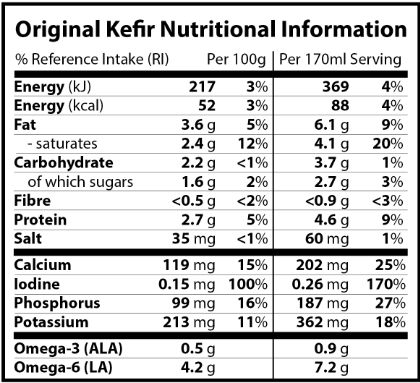
In the UK, the law requires all nutrition labels to show nutritional values per 100g or 100ml, but they may also be displayed per portion or serving too.1https://www.nutrition.org.uk/food-labelling/
You may also see a percentage called the Reference Intake (RI). This shows how much a nutrient in a portion contributes towards the reference amount for an average adult. For example, a 170ml serving of our Original Kefir provides 9% of the reference intake for protein.
What do the different nutrients mean & what should you look for?
Here’s a quick breakdown of the nutritional information you’ll commonly find on food labels.
| Label information | What it means | What to look for |
| Energy (kJ/kcal) | How much energy the food provides. | Compare similar products and consider your overall needs and portion size. |
| Fat | The total amount of fat in the food. | Consider the type of fat as well as the total amount. |
| Of which saturates | The amount of saturated fat within the total fat content. | Be mindful of your overall saturated fat intake and compare similar products. |
| Carbohydrates | The total carbohydrate content, including sugars and starches. | Look at the sugars figure separately and consider whether the food provides fibre too. |
| Of which sugars | The total sugars in the product, including naturally occurring and added sugars. | Check the ingredients list to help distinguish sources. |
| Protein | The amount of protein provided. | Consider whether the product contributes to your overall protein intake. |
| Salt | The amount of salt in the food. | Remember that salt can add up across meals and snacks throughout the day. |
| Fibre | The amount of dietary fibre, where declared. | Look for fibre-rich options, particularly wholegrains, beans, pulses and other plant foods. |
| Any other vitamin or mineral, e.g. calcium, potassium | The amount of that vitamin or mineral in the food. | Consider how the product contributes to your overall intake of these nutrients. |
Only the energy, fat, [fat] of which saturates, carbohydrates, [carbohydrates] of which sugars, protein and salt figures are legally required to be on labels. Any others, such as fibre or different vitamins and minerals, are extras which you may or may not see.
How to read the ingredients list
The ingredients list can tell you a lot about what’s really in a food, beyond the claims on the front of the packet.
Ingredients are listed in descending order by weight, so the first few ingredients make up the largest proportion of the product.2https://www.nhs.uk/live-well/eat-well/how-to-read-food-labels/
Added sugars
Sugar can appear under several different names, including glucose syrup, dextrose, maltose and fructose. Checking the ingredients list can help you identify different sources of sugar.
Remember that the sugars figure in the nutrition table includes both naturally occurring sugars (such as those found in milk and fruit) and added sugars. It doesn’t distinguish between the two.
Fats & oils
Look at which fats and oils have been used. Different types of fat have different nutritional properties, so it’s useful to consider the ingredients alongside the total and saturated fat figures.
Additives & flavourings
You might notice ingredients such as emulsifiers, flavourings and colourings. These ingredients can serve different purposes, from improving texture and consistency to helping food last longer. Their presence doesn’t automatically mean a food is unhealthy, but the ingredients list can help you understand how a product is made.
Don’t forget to check allergens!
If you have a food allergy, checking the ingredients list is particularly important.
In the UK, 14 allergens must be emphasised in the ingredients list when they are used as ingredients, often in bold text. These include milk, eggs, peanuts, tree nuts, soya, gluten-containing cereals, fish, crustaceans, molluscs, sesame, mustard, celery, lupin, and sulphur dioxide and sulphites above the specified threshold.3https://www.gov.uk/allergen-labelling
If you have a food allergy, always read the label carefully, even on products you’ve bought before, as ingredients can change. You may also see precautionary statements such as “may contain nuts”, which indicate a potential risk of cross-contamination. These warnings are voluntary, so their absence does not guarantee that a product is free from traces of an allergen.4https://www.gov.uk/precautionary-allergen-labelling-pal
What do traffic light labels mean?
You may have noticed traffic light labels on the front of packets such as pizza, cereal or other packaged foods. They display calories, fat, saturates, sugars and salt with red, amber or green behind each value. It will usually show the values of each per serving or per 100g, alongside the % Reference Intake.
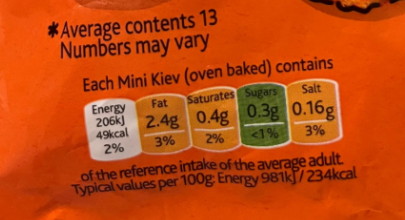
5https://www.nutrition.org.uk/creating-a-healthy-diet/food-labelling/
Here’s what the colours mean:
- 🟢 Green – Low: The product contains a low amount of that nutrient.
- 🟠 Amber – Medium: The product contains a moderate amount.
- 🔴 Red – High: The product contains a high amount, so it’s worth being mindful of how much you consume.
There is no legal requirement to put traffic light labelling on products.6https://www.bda.uk.com/food-labelling-information But many packaged products will have them for quick reference.
A red indicator doesn’t mean a food is forbidden, and a product with lots of green indicators isn’t automatically the most nutritious choice overall. It’s important to look at what you’re eating over the whole day.
For example, olive oil may be a useful source of unsaturated fat but still have a red indicator for total fat. Likewise, a plain yoghurt with naturally occurring milk sugars may display a higher sugar figure than expected without having added sugar.
Use traffic lights as a quick comparison tool for similar products, but always make sure to check the ingredients and wider nutritional information.
Ultra-processed foods: What should you look out for?
With ultra-processed foods (UPFs) becoming an increasingly popular topic in the media, you may have heard experts such as Professor Tim Spector discussing how the foods we eat are made and what this could mean for our health.
Books, documentaries and news coverage have brought the subject into the spotlight, but how do we actually define an ultra-processed food?7https://www.theguardian.com/banning-ultra-processed-food
One way researchers classify foods is through the NOVA food classification system, which groups foods into four categories according to the extent and purpose of their processing.
They are as follows:8https://pmc.ncbi.nlm.nih.gov/articles/
- Group 1: Unprocessed or minimally processed foods – Foods in their natural state or altered through simple processes such as washing, chopping, freezing, drying or pasteurising, without adding salt, sugar or fat. Examples include fresh fruit and vegetables, eggs, plain milk, oats, rice, meat and frozen peas.
- Group 2: Processed culinary ingredients – Ingredients extracted from foods or nature that are generally used in cooking rather than eaten on their own. Examples include olive oil, butter, sugar, salt and honey.
- Group 3: Processed foods – Foods made by combining Group 1 foods with ingredients such as salt, sugar or oil, often to preserve them or improve their flavour. Examples include tinned beans in salted water, salted nuts, traditional cheese and some freshly made breads.
- Group 4: Ultra-processed foods (UPFs) – Industrially formulated products often made using ingredients or additives not typically used in everyday home cooking. These may include flavourings, colourings, emulsifiers, modified starches and protein isolates. Examples can include fizzy drinks, packaged snacks, instant noodles, some breakfast cereals and ready meals.
It’s worth noting that frozen vegetables, tinned beans, pasteurised milk and wholemeal bread can all undergo processing while still being useful parts of a healthy diet. The category depends on more than whether a food has been cooked, frozen, canned or packaged.
Not all processed foods are bad for you, and if they’re a small part of your diet, you can still live a healthy lifestyle. We believe in the 80/20 rule here at Chuckling Goat! 80% healthy, whole foods and 20% a little treat – balance is key.
How can you spot potential UPFs on an ingredients list?
Certain clues may indicate an ultra-processed formulation, including:
- Ingredients rarely used in ordinary home cooking, such as some modified starches, protein isolates and certain industrially produced ingredients.
- Some flavourings, colourings, emulsifiers and sweeteners.
- Formulations combining several refined ingredients to create a particular texture, flavour or shelf life.
If you’re choosing foods for every meal with lots of extra processed ingredients, and high values for your % Reference Intake, you may accidentally be eating more fats, salts or sugar than is healthy for the average person.
So if you’re looking to eat healthier, it’s worth having a look at all the information on a packet to see how it fits into your overall daily diet. Fresh fruit and vegetables, wholegrains, beans, pulses and other nourishing ingredients are all great places to start.
Your food label checklist: 6 things to remember
Next time you’re doing your weekly food shop, here’s a handy checklist to help you understand what you’re buying.
- Compare the nutrition figures per 100g when choosing between similar products.
- Check sugars, saturated fat and salt, as well as energy.
- Look at the fibre and protein content where relevant.
- Read the first few ingredients to see what the food is mainly made from.
- Check allergens and any ingredients you personally need to avoid.
- Consider how processed the food is and how it fits into your overall diet.
Ultimately, healthy eating isn’t about getting every decision right or avoiding certain foods altogether! It’s about understanding what goes into the food you eat, learning to make more informed choices over time, and finding a balance that works for you.
By getting to grips with food labels, you can feel more confident about what you’re putting in your trolley and build a varied, balanced diet that nourishes your body and supports your overall health.
Remember, small changes can add up, and a healthier lifestyle starts with progress, not perfection!
Want more tips on making informed food choices? Take a look at our article, Ditch the junk: 5 simple ways to reduce ultra-processed foods!
Any questions? Contact one of our Nutritional Therapists via live chat, weekdays from 8 am to 8 pm.
References
- 1
- 2
- 3
- 4
- 5
- 6
- 7
- 8